Things I DON’T Have in Common with the Tech Bros

Well, let me start first with the things I DO like that they (Silicon Valley tech bros like Elon Musk and Peter Thiel) also are known to like.

I like the first 80% of Atlas Shrugged.

I do still love Douglas Adams. Mostly.

But I think I don’t like Iain M. Banks. I read somewhere that Elon and his buddies have referenced in multiple instances their love of Banks’ Culture series of space opera novels. So in my casual side quest to read what they read, to understand their motivations for controlling this current hellish movement in American history, I downloaded a copy of Consider Phlebas, the first book of the Culture series.

And it’s bad.

I’m only 43% in, and I recall seeing some user reviews that suggest the first book isn’t well regarded and the series gets much, much better. But my lack of faith in that opinion is like arguing with someone against Jordan Peterson, when they say “But you really have to watch this 3 hour video he did on personal responsibility and the importance of tidiness” or “You really have to watch these 7 videos of him DESTROYING these left wing cucks in carefully curated straw man debates”. Uh, no I don’t.

There’s enough for me to dislike already.

First, there is very little that’s compelling about the main character, Horza, a “Changer” operative that can impersonate anyone and has advanced self-bio-hacking abilities. Yawn.

Then, eventually, he is dropped into a “the natives are restless” hostile island situation, where the villain is this disgustingly obese (see, I avoided using the word morbidly which is so overdone) corpulent cesspool of a tyrant. And it’s just so gross and cruel and without purpose or reason, to get so graphic and torturous. I feel like the intention is to be funny, but it’s dreadfully unfunny, and lacking of the wit and underlying kindness of say, Douglas Adams in Hitchhiker’s Guide.

And then there’s this casual tossing around of words like slut and bitch to refer to incidental background character women. I imagine it’s possible to explain this away as “it was a different time”, which I imagine to be the 90’s and early oughts. But still, it’s just done so artlessly and without humour. It’s out of touch and dated.

Anyway, I am struggling to finish this one and won’t be buying more.

Give me my woke-ass appreciation of Octavia Butler anytime. That shit is breathtaking, especially in comparison to this apparently upwardly-failing Englishman, may he rest in peace.
Trump is Playing RISK

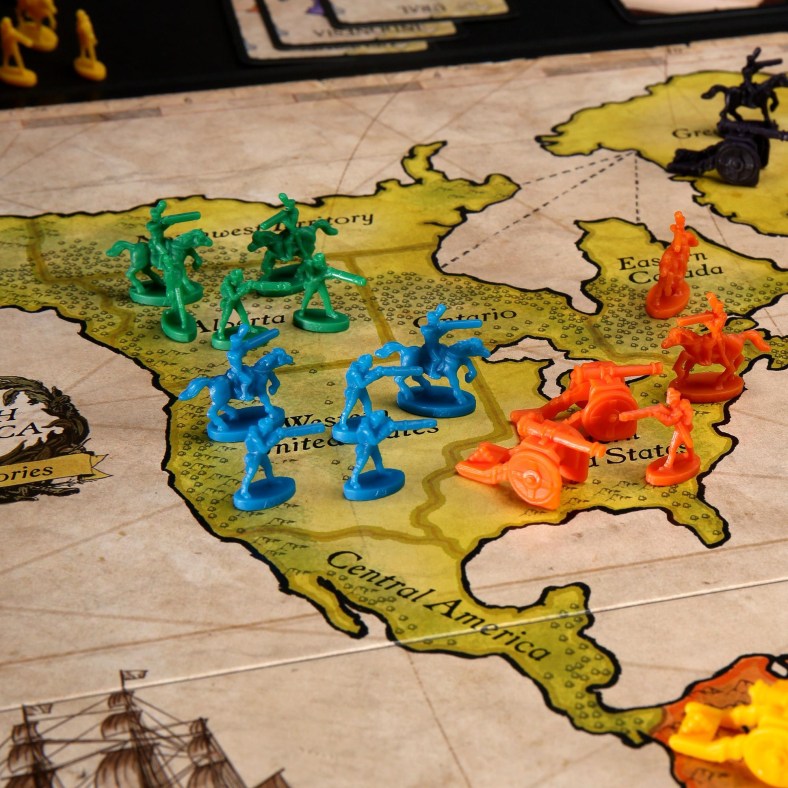
Reviewing the week’s news, I can’t help but see some intentions emerging from the deliberately overwhelming flurry of Trump’s first few days of his second term, including his Davos address. I think his expansionist rhetoric is real – he intends to use economic, if not purely military, force to form an American protectorate across North and Central America, with Greenland added in to boot. His “jokes”, at first seemingly insane, are more than jokes.

Why am I thinking about the board game RISK? I think Greenland is in there mostly because it looks so huge up there on a Mercator projection of the world. For his ego, he wants to grab all that far northern territory, and take credit for doing it.

And Panama, it’s right next to U.S. controlled Costa Rica, so might as well grab that and secure the trade route to remove Chinese influence.

Canada is weak politically right now, and will hold out from a sovereign perspective, but would give up a lot of other concessions.

And Mexico, as a population (consumer) source would be amazing. It just needs to be brought in line for investment, and the declaration of the cartels as terrorists will allow bombing of their bases, sure to become popular with many, Mexicans included. Gaza has shown that people’s tolerance for indiscriminate loss of collateral human life is pliable if challenged relentlessly.

Coupled with withdrawal from other zones of the world stage (leaving Europe to fend for themselves, abandoning Taiwan), we might be seeing the emergence of the Orwellian world order of 1984. Oceania, Eurasia, Eastasia. Great.

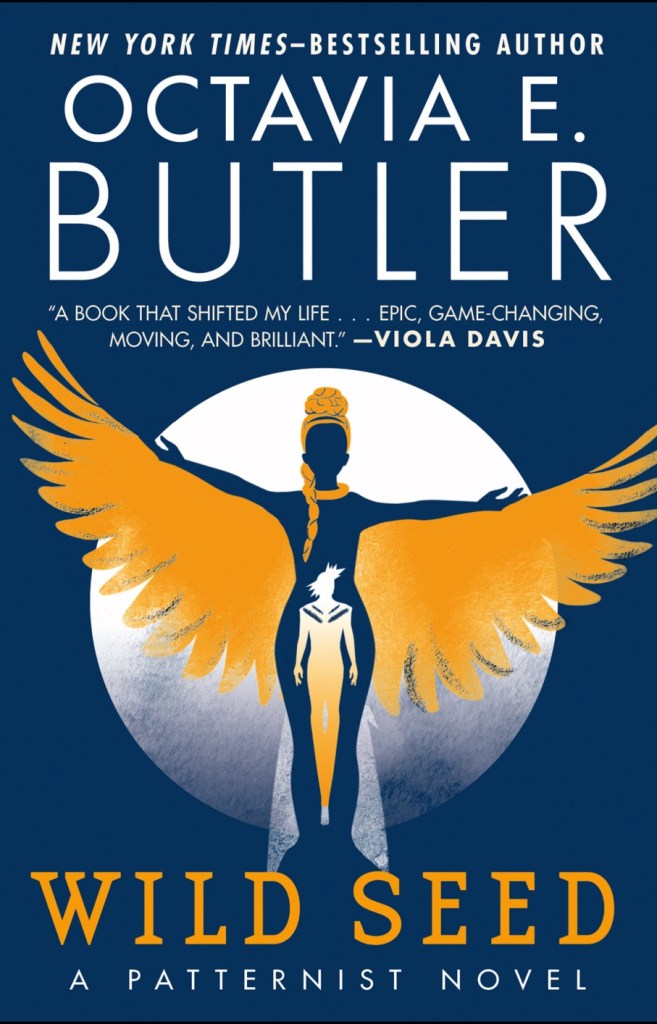
Wild Seed by Octavia Butler

It’s Black History Month, and so I have just started reading Mind of My Mind, the 2nd book in Octavia Butler’s Patternist series (4 books). But dipping back in after purchasing it on my Kindle (I had read the sample earlier, the publishers had made the smart choice of offering almost a quarter for the book for free, so I was re-reading at first) brought back the memories of the 1st book of the series, Wild Seed.

That book was unlike anything I’d read, truly unique and it introduced me to Butler’s singular voice. I’m not sure I’ve read Parable of the Sower, her more famous work, I’ll have to go back and check… but Wild Seed was intense and arresting.

How appropriate for Black History Month, because the premise of the story is about subjugation and is a speculative projection of what true enslavement would look like. What if your very mind could be enslaved? What if harm to those you love could trap you to a malevolent, sinister will?

The main villain, Doro, can consume the mind and take over the body of anyone. And the initial protagonist, also immortal in a way, can shift her body into any shape. What follows is an intensely dark, cruel, and disturbing unfolding of events, plumbing the depths of violence starting from the time of slave trading in Africa.

The epic, intergenerational story is relieved from time to time by human moments of tenderness and compassion in the face of horrific situations, but on the whole it’s a melancholy and utterly engrossing read. Truly a one of a kind achievement.

In this time of reflection, by negative and opposite example, it shows that in reality, enslavement never truly meant ownership of another person, because at the core, the person’s mind was free. When even that freedom is taken away, what could result is absolutely chilling.

5 Helmets out of 5

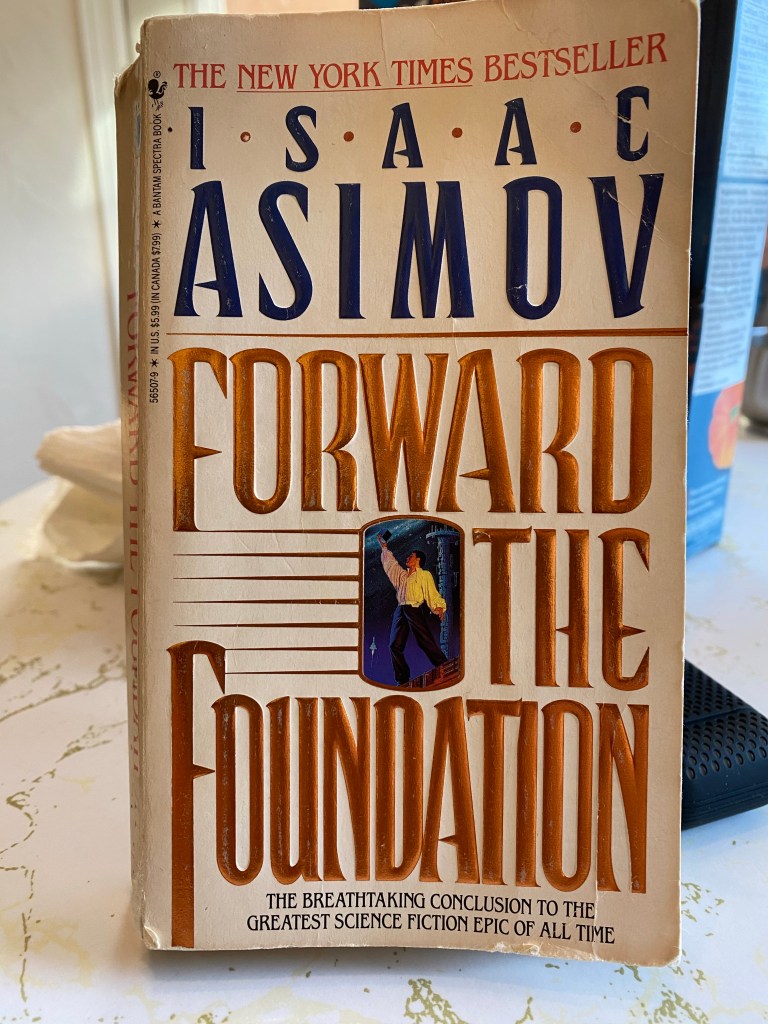
Forward The Foundation by Isaac Asimov

Not great. This has somewhat interesting plot lines for the first 2 thirds of the book, concerning Raych, but it really really peters out at the end, in the manner of a tired, out of touch old man. I mean both Hari Seldon and Asimov himself. The last third dotes on uncomfortable descriptions of Hari’s blond, beautiful, attractive granddaughter who helps Hari tie up a few loose ends in a rote, boring way.

Tarnishes the series a bit for me honestly. He can really be pompous and arrogant, Asimov, in his ideas that smart people know better than everyone else and should be trusted with manipulative ability to “push” people with their mentalic powers. Interesting, I was just watching Gen V and one of the main characters also refers to her similar abilities as “pushing”. I wonder if Asimov used it first.

I’m about to donate this book so here’s the record that I read it. 2 Helmets out of 5.

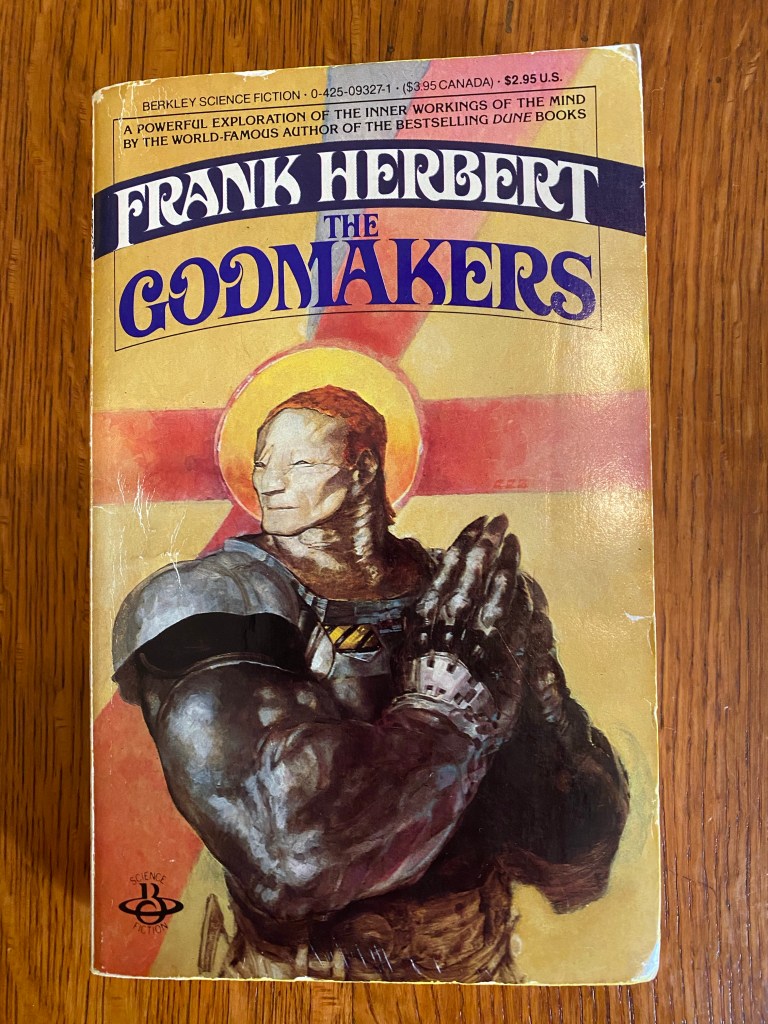
The Godmakers by Frank Herbert

I seem to have a soft spot for science fiction novels with the word “God” in the title. And Frank Herbert’s name has some resonance for me. Although I am not a huge Dune fan, I do admire the novel, and quote weird funny lines from the film every now and again, in conversation. So I gave this a try.

It’s just okay, I guess. There are some Big, Weighty Issues presented, but the way they are tackled is disjointed at times, with some chapters meant to be payoffs turning out to be flops after unwarranted build up. This feels like the sketch of a better book, highly episodic in nature.

Once thing I do like is the disgruntled snarkiness of the protagonist, Lewis Orne, and the combative relationship with his asshole boss, Stetson. Orne acts like a really sulky son-of-a-bitch when he’s first called out and criticized, and to be fair, Stetson really rips into him with ridiculously funny churlishness.

One of the phrases in the book is “Gods are made, not born.” This makes some sense, actually, in the way that religion fashions gods, and in the other way that true “creator of the universe”-type gods ought not to have an origin story. Oh, and in the third way that there are priests literally making gods out of thin air by sitting in a circle and chanting.

The casual sexism is amusing, as a capsule of its time. Our hero encounters not one, but two fiercely female-led societies, one open and the other secret. The first is an authoritarian witch-planet that nearly kills him, and the second is a vast conspiracy of wives bent on manipulating their husbands into positions of power. Cool.

All these episodes culminate in a ordeal, a trial for Orne. It’s sort of a vague cacophony of religious mumbo jumbo that strains to hang all the ideas together, but just treads water attempting to do so.  The final confrontation works pretty well, though, evoking some swelling sense of awe, before the whole thing ends quite perfunctorily.

I did like some of it. 

I give this book a rating of 2.5 Helmets out of 5.


Blogging in the Time of Pandemic

So here we are in the thick of it, sequestered in our homes as COVID-19 spreads silently but surely through our communities. Terms we might remember from this time are “social distancing” and “flattening the curve” and “community spread”. I would imagine I’m not the only person returning to my half forgotten blog.

Another phrase I’ve heard a lot is that old adage “Perfect is the enemy of good”, which Google informs me is attributed to Voltaire. I might just go ahead and bust out a few blog entries without worrying about perfecting them, since they are mostly for me anyway.

Being home for now weeks on end with my wife and 2 year old son has been a blessing. What a wonderful time of his life to be so present in nearly every moment. It makes me also look forward to the day when he can read some of my favourite science fiction, and inspires me to record some of my thoughts on what I’m reading, and what I’ve recently read, in case that interests him at some point. Maybe he’ll discover some of these books in my library, or floating around in my Kindle cloud.

I use “recently” extremely loosely, as some of the most inspiring and affecting books I’ve read have been in these last 5 years or so. This past year I read The Disposessed, and finished the entire Expanse series. And before that The Starmaker blew my mind, and before that The Three-Body Problem series. These influences ought to figure prominently in my ever-germinating novel idea.

So here we go! Let’s do this thing.

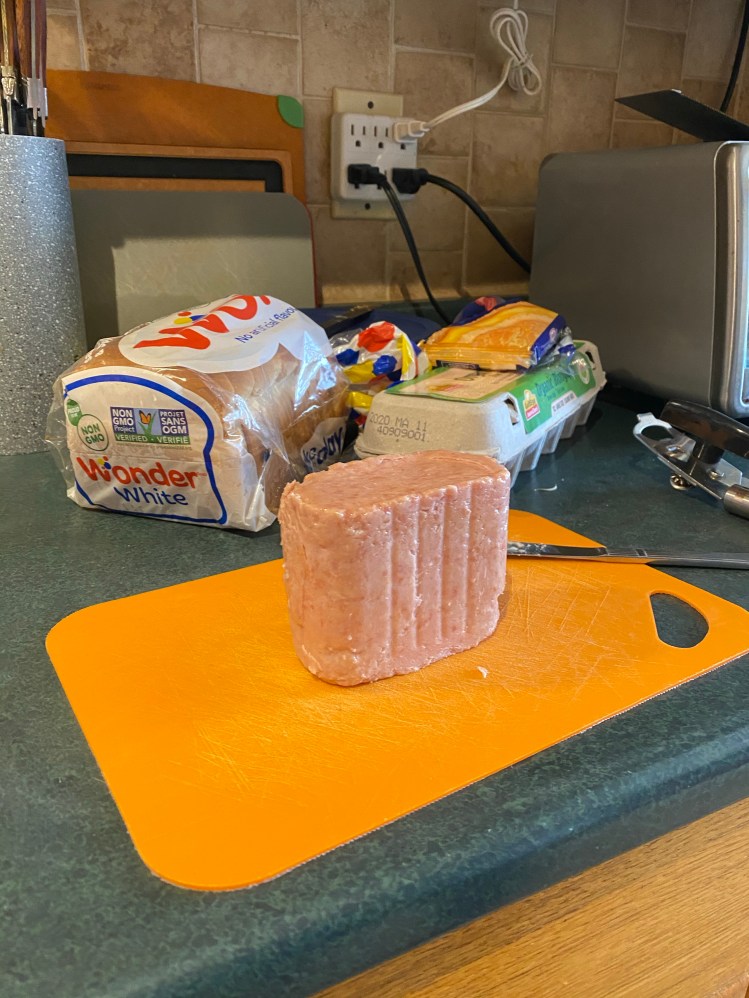
Oh why the picture of Spam? I looked for a picture in my roll that suggested Pandemic, and nothing inspires you to buy and consume canned meat like seeing long lines to get into the grocery store.

Favorite Star Trek Episodes… To Hate

There are lots of people who write about their favorite Star Trek episodes, but I thought I’d try something different. I’m going to list my favorite Star Trek episodes to hate. To loathe. To rip apart, piece by putrid piece, on the Internet or at the pub.

You see, this evening I watched the notoriously bad Deep Space Nine episode “Profit and Lace”. It features Quark in drag. Yeah. Here’s the trailer:

I have all of Deep Space Nine available on demand from the cable company, and even though I profess to be a total Trekkie, I am woefully incomplete in watching the entire canon. I haven’t watched most of Voyager, only watched about a third of Deep Space Nine, and missed the back half of Enterprise. I’m told that Deep Space Nine is the best of all these, so I dove right into Season 6 and intend to watch to the end, before maybe starting again from the beginning.

So my wife and I have worked through most of Season 6 (pleasantly surprised), and came upon “Profit and Lace”. Afterwards, I turned to my wife and said “Weird, but that was pretty entertaining.” She said, “What the hell are you on? That was a nightmare. Maybe the worst episode ever.” I thought it was a funny take on women’s rights (Ferengi woman were finally given the right to wear clothes!) and it was progressive given how backwards Ferengi were about gender. My wife thought the whole episode was sexist and creepy and just… just horrible.

I agreed it was bad, but at least it was entertainingly bad. If I were to pick a worst episode at this point, it would have been a bit earlier in the same season. The episode was “His Way” and featured Odo learning to woo Kira from a holographic lounge singer, Vic. That episode was INTERMINABLE for me. We had to watch the improbably sentient and inexplicably powerful Vic sing an entire song while Odo pretended (yes PRETENDED) to play the piano.

However, the online vitriol against “Profit and Lace” is far more intense. It brings to mind the concept of fans targeting an episode that is so tonally different from the rest of a series that it becomes legendary in its badness.

For Star Trek: The Next Generation, that episode is probably “Samaritan Snare”, where a bunch of… simpletons, let’s say… abduct Geordi and force him to fix their ship. “We look for things. Things we need. Things that make us go.” Cringe. Nonetheless my brother and I still quote lines from it to each other, to this day.

My wife says the corresponding episode from Star Trek (The Original Series) is “Spock’s Brain”. I haven’t seen that in a long time, so I’ll have to re-watch that to see if I agree.

What’s your favorite Star Trek episode to hate?