How did I get to Ayn Rand? Not the usual way. I was listening to an episode of the podcast Uncanny Valley, “Is Silicon Valley Actually Libertarian” and they were discussing how Atlas Shrugged is one of the foundational Ur texts of the so-called libertarian tech bro movement. I realized I’d never read it and sought out to do so. I had an idea of what it was about but I wanted to evaluate to source text for myself .
I think I’ve always had an unconscious bias against Rand because of how she’s referenced historically, and imagined a dry, preaching tome of ideology. And even if that might be true to some degree, I found that instead I was surprised by how delightfully compelling her writing and narrative turned out to be. I’m really enjoying this book.
This is not a review and just the first impressions of the first several chapters, but the examples of autistic traits are so clear to me, and so finely wrought in prose.
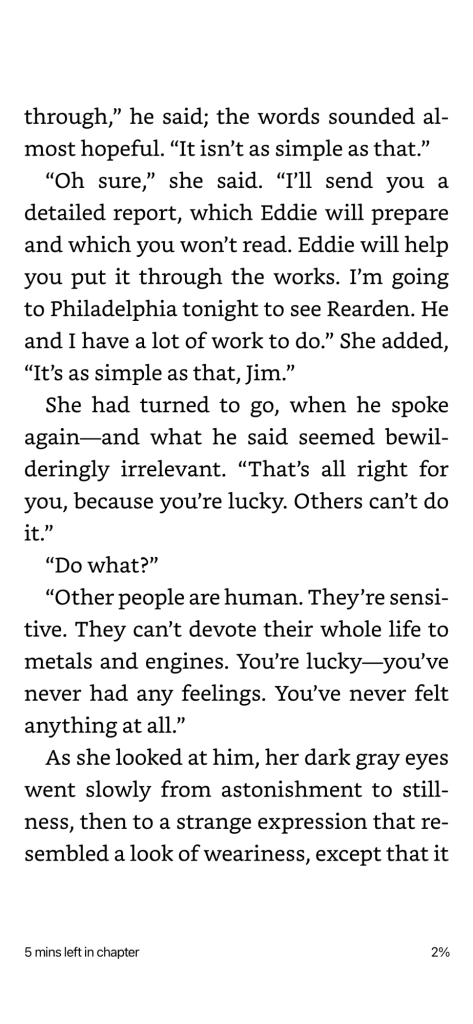
Dagny Taggart is autistic:
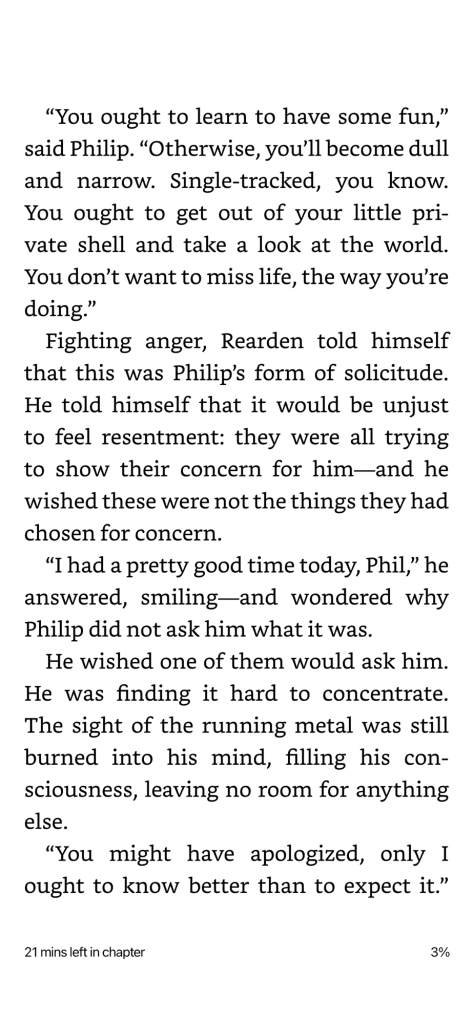
Hank Reardon is also, totally autistic, in this scene hyper-focused on the new type of steel he had developed, during a social situation:
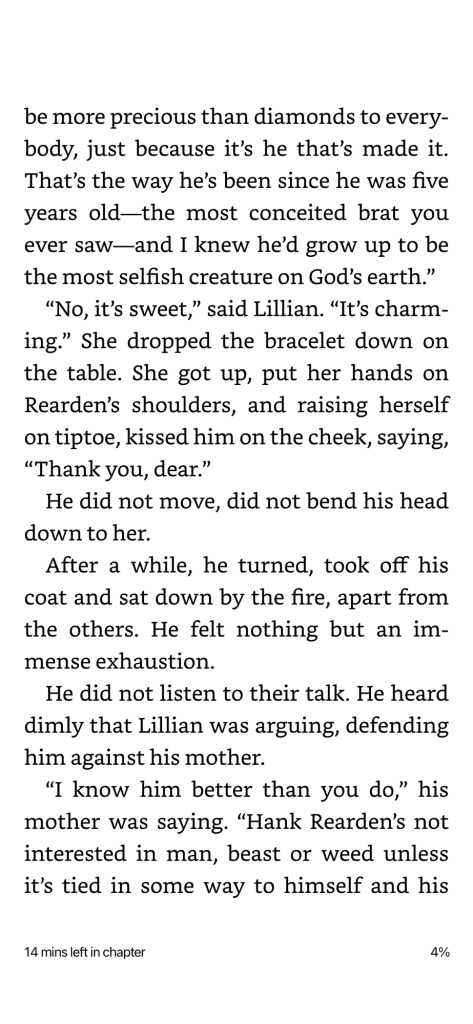
And here is Hank suffering from autistic overwhelm:
Just wanted to get these thoughts out for now. I may have more to say after I’ve finished the book. (Editor’s Note: I drafted this post months ago so I have since finished it.) I also have a whole, long piece I’m envisioning on the intensely autistic themes of Octavia Butler’s oeuvre, but that will need to remain in draft for now.
Reviewing the week’s news, I can’t help but see some intentions emerging from the deliberately overwhelming flurry of Trump’s first few days of his second term, including his Davos address. I think his expansionist rhetoric is real – he intends to use economic, if not purely military, force to form an American protectorate across North and Central America, with Greenland added in to boot. His “jokes”, at first seemingly insane, are more than jokes.
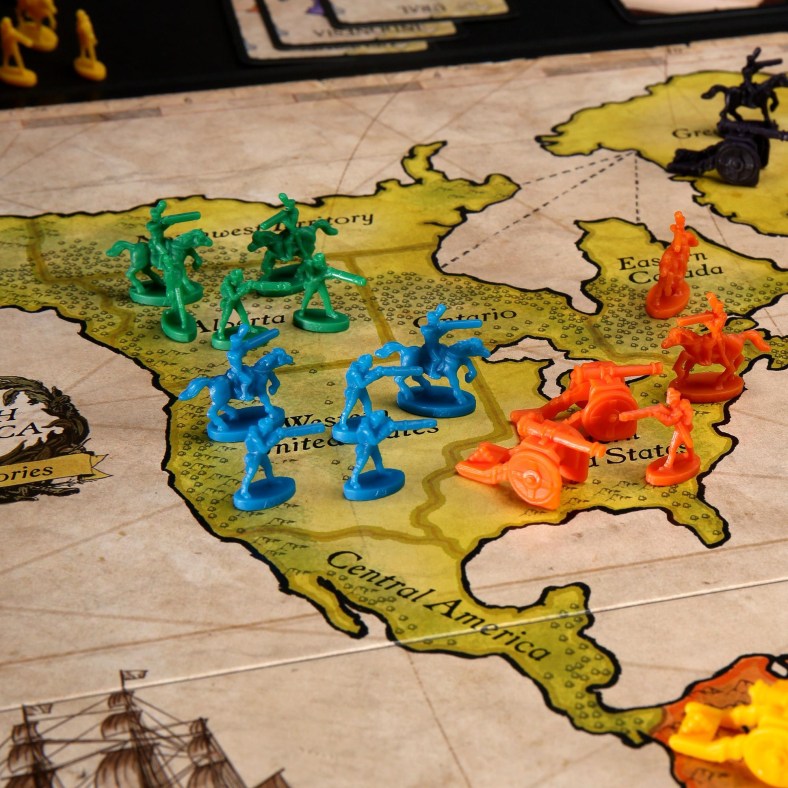
Why am I thinking about the board game RISK? I think Greenland is in there mostly because it looks so huge up there on a Mercator projection of the world. For his ego, he wants to grab all that far northern territory, and take credit for doing it.
And Panama, it’s right next to U.S. controlled Costa Rica, so might as well grab that and secure the trade route to remove Chinese influence.
Canada is weak politically right now, and will hold out from a sovereign perspective, but would give up a lot of other concessions.
And Mexico, as a population (consumer) source would be amazing. It just needs to be brought in line for investment, and the declaration of the cartels as terrorists will allow bombing of their bases, sure to become popular with many, Mexicans included. Gaza has shown that people’s tolerance for indiscriminate loss of collateral human life is pliable if challenged relentlessly.
Coupled with withdrawal from other zones of the world stage (leaving Europe to fend for themselves, abandoning Taiwan), we might be seeing the emergence of the Orwellian world order of 1984. Oceania, Eurasia, Eastasia. Great.
I have a six year old son. He’s loving, funny, joyful, smart, persistent, and determined. He’s not fearless but he is adventurous. He has been the most rewarding experience of my life. He’s also autistic.
I’d say he has mild support needs, but he does have a disability in the form of a significant speech delay, so we have some challenges and worries, along with the frequent, overflowing hits of joy he provides. He’s everything to me, and in my mind, he has become the primary future audience I am writing to in this blog. I want him to know what his dad was into, what his dad was thinking about. And so it’s time for me to write this now, so that he knows the main thing I think about now is him.
We’re on vacation and have rented a place up in Bracebridge, for the third time in a couple years. Since we don’t own a cottage (the great divider in Ontario, rarely acknowledged in polite company, between old-money Haves and new-money Have-Nots) we are attempting to solidify a “family cottage” childhood experience for our son by renting the same place on AirBNB over and over again. It’s kinda working. And even though, per night, it’s quite expensive, it’s not nearly as expensive as buying and maintaining a cottage.
A couple days ago we went to nearby High Falls, and right next to it, Potts Falls. The three of us, my wife, my son, and I, ventured out past a guard rail and gingerly stepped onto a rocky outcropping overlooking both falls. We were quite proud of ourselves, and snapped a few pictures. My boy, of course, wanted to go close to the edges but we wouldn’t let him, keeping him at least 6 feet from any steep drop. He’s a little… sporadic in his movements sometimes, especially when he’s happy and excited. So I get nervous, wary of hops and flaps that sometimes catch even him by surprise.
We had the area to ourselves until suddenly, a group of 5 or 6 children, mostly bronzed and tousled-haired boys with a few little blonde girls in the mix, fanned out excitedly around us. Their parents, a couple of similarly sun-bronzed moms and a fit, blustery dad were a little bit behind and soon joined us. But before they did, one boy in particular, couldn’t have been more than 4 years old, wandered right up to the edge of the falls and danced on the edge. Eventually I heard someone casually call him back. But he and his siblings and friends continued to scramble around up there, some disappearing over an edge to land on an outcropping below, I presume. I smiled wanly, not meeting anyone’s eyes, something I tend to do with strangers, but inside I was cringing the heck out. Jesus. I did NOT want to see anyone have an accident, and then, have to be involved (banish the selfish thought). After a short time, I couldn’t stand it any longer and hustled my family away, sensing the same sentiment from my wife.
We found a trail, and decided to take off into the forest. Along the way, we saw a sign for portage (a person carrying a canoe), which we figured out might lead next to the lake and a view of the falls from below. Indeed it did. It led to a clearing and then a stony beach, which was at the foot of Potts Falls, the smaller of the two falls, still about 3 or 4 stories tall. We gingerly explored the shoreline. Our swim suits where way up back at the car, so I rolled up my son’s long sweat pants and let him dip his feet in the water. I was wearing waterproof Timberlands so I followed along. My wife was wearing city Skechers so she stayed behind on a log.
Soon, the bronzed outdoors tribe, still dressed in swim suits and carrying a few towels, emerged onto the beach as well. The children immediately jumped into the lake and started roughhousing around. Some of them jumped into the water, hardly looking where they leaped. The adults joined in.
I glanced at my son, gauging whether he wanted to investigate and perhaps join in. But of course, that is not typically his way. He’s often content to be off to the side, sometimes observing, so that’s what we did.
And this happy, outdoorsy, naturally social bunch had a lovely time, climbing up and down the falls, floating and playing in the frigid waters, hooting and hollering. We couldn’t help but feel a little sheepish. Why couldn’t we be like that, so carefree and confident? I mean, we had a nice time too, my son picking his way down the shoreline in his bare feet, and me following behind in mine (I had shed my shoes). We found the one warm patch of water in the sun, and stood there in the shallows, 2 feet from the water’s edge. I beckoned my wife to come in. No thanks, she said.
Eventually she did come in, and found a rock to sit on with her feet in the water. We moved our way back towards her and my son waded out a bit further to find a similar rock. By now, the sun-kissed, blessed and invincible family group had gone, having climbed the waterfall that after all, ascended in manageable chunks, each no more than half a person’s height. My son found a rock near all of that, and perched on it.
Sensing he wanted to go further, I rolled up his sweat pants a little more, till they were halfway up his thighs. He looked funny with his pants bunched way up like that. I was in shorts so I was already okay. Sure enough he waded into the water a bit more. Now he was just to the right of the waterfall, and it was getting too deep for even his extra rolled up pants. I laid my hand on his shoulder and tried to coax him back to shore.
He didn’t budge. My son, who speaks much, but in a generally “younger than his age” and sometimes echolalic way, looked at me and said, “I want to climb the water stairs.”
I paused.
“Do you mean you want to climb up this waterfall?” I asked, doubtfully, looking up at the top, which was as I said, maybe 3 or 4 stories high. I had never, in my life, climbed a waterfall.
“Yes.”
Well, there did seem to be plenty of foot holds. And the water, cascading down, was not very intense and left plenty little pools and plateaus where we could rest. The falls sloped up not so steeply that we would be forced to get soaked. I thought about a rustic park fountain we sometimes passed by, back home in Toronto, that featured water cascading down rocks to a pool below, and how each time we passed it I held my son back from climbing to the very top, because we “weren’t supposed to”. No one was telling us not to now. And he had just seen a bunch of kids do it.
I called back to my wife, who by now was sitting on her log again.
“Hey, we’re going to climb this waterfall. Can you go back up the trail and bring our stuff to the top?”
She only hesitated for a second, and then said yes. I think she read the situation perfectly.
I lifted my son out of the water and onto the first ledge. I hauled my own unfit rickety body up there too. And then foothold by foothold, we ascended the waterfall. I would brace myself on firm-ish footing behind my son, and in my shadow underneath my body, he tested and tried different ways to place his own feet to climb. A few times I guided his hands up to grip edges, to stabilize himself.
Gingerly, we stepped into little pools of water, finding the bottoms slippery with moss. But my son kept finding his footing, still in my enveloping shadow, as I scaffolded his climb in case he slipped. But he didn’t slip. And a few times we could have gone off the side of the waterfall onto solid ground, an easier path up. But we didn’t. My wife had accessed some of those points too, and held out her hand in case he wanted to get off. He waved her off each time. He kept right on climbing, until we got right to the very top, where his mom ended up, waiting with our shoes and just the biggest smile on her face.
Wonderful. We did it.
I read Octavia Butler’s “Parable of the Sower” recently. There is a quote from it that made me think about my son. Here it is, a quote from its fictional holy text, EARTHSEED: THE BOOKS OF THE LIVING, by Lauren Oya Olamina (actually Octavia Butler):
Prodigy is, at its essence, adaptability and persistent, positive obsession. Without persistence, what remains remains is an enthusiasm of the moment.
Octavia Butler
P.S. The very few of you who know me in real life, please be aware that it is customary for autistic people not to be “outed” by other people. So while I write anonymously here that my son is autistic, that doesn’t mean I want it mentioned on my social media for anyone to see. I prefer to leave that right and preference to my son himself, when he comes of age.
There are several particular things a man can learn to do around the house that, once properly mastered using the correct procedure, become supremely satisfying and useful, for all time.
The three things that come to mind are:
1. How to carve a watermelon into those little Christmas tree shapes you sometimes see at restaurants.
2. How to fold a fitted bedsheet into a rectangle.
3. How to break down a cooked chicken into parts.
You can find the correct procedures on Youtube and maybe Instagram. These are fairly easy to learn, and take a bit of effort to understand, but it’s really gratifying effort. Once practiced about 3 times, any stress you may have had about these tasks will melt away forever and ever.
Here’s a couple of bonus tips that have also made something that was a chore a stress-free, almost welcome diversion.
– Pop in a single wireless airbud and listen to podcasts while doing dishes.
– Learn how to fold clothes the Marie Kondo way, particularly t-shirts so they can be inserted like books on a bookshelf edgewise into your drawers, sorted from darkest to lightest colors.
So I’m reading physicist Brian Greene’s new book, “Till the End of Time”, and in it he references Michael Graziano’s schema-based theory of consciousness, under a nicely succinct subheading “The Mind Modeling The Mind”. The theory is, basically, when a conscious mind is contemplating an object (in Greene’s example, a Ferrari), it creates a simplified model of that object and its attributes, but furthermore, it creates a model of a conscious mind paying attention to that object. This model of the mind is what give us the feeling of being conscious.
That made me think (and I’m trying to remember if it was discussed in Graziano’s book) that the defining characteristic of being conscious is the temporal concept of “now”. That is to say, a subjective (to me, myself, and I) moment in time that moves through a narrative, a story of what’s happening right now to that model of myself paying attention to something. It’s this concept of “now” that can then process any “then” (not now) – in other words, the past and the future. The now, the conscious present, can dive into the data of the recorded past (in my brain) to project a simulation of the future.
Sounds exhausting. That’s probably why we need to sleep, or lose consciousness, periodically, during which we lose all concept of now (unless we are consciously dreaming). Our brains clearly need rest from this exhausting effort of modeling our current moment in time, all the time.
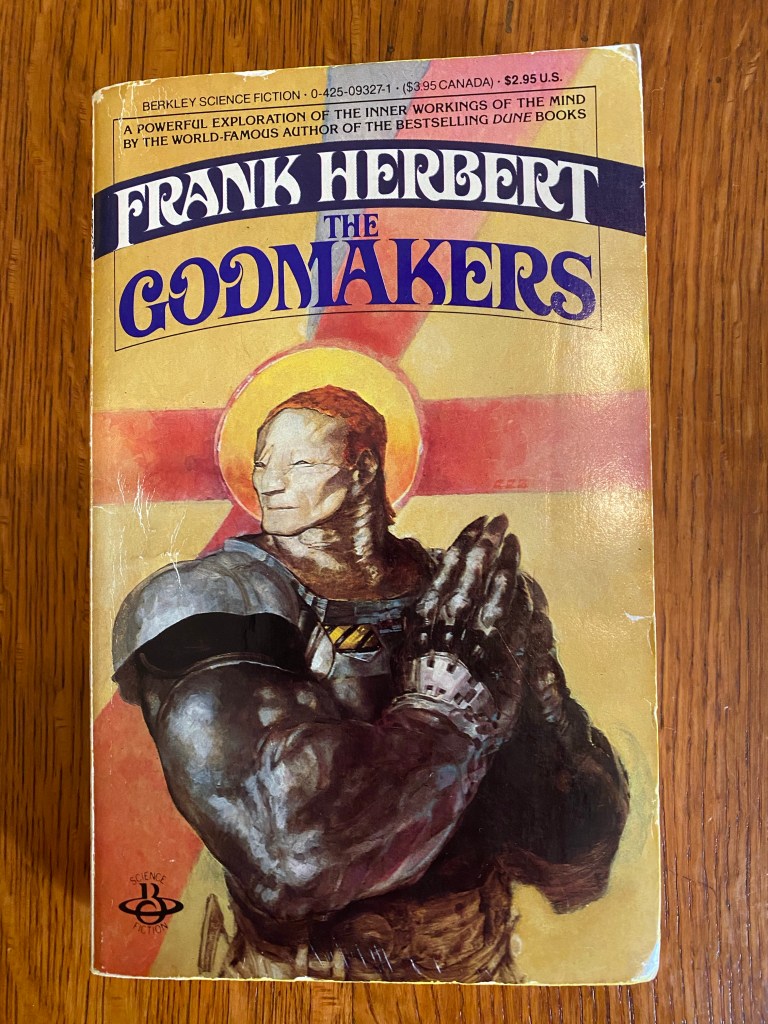
I seem to have a soft spot for science fiction novels with the word “God” in the title. And Frank Herbert’s name has some resonance for me. Although I am not a huge Dune fan, I do admire the novel, and quote weird funny lines from the film every now and again, in conversation. So I gave this a try.
It’s just okay, I guess. There are some Big, Weighty Issues presented, but the way they are tackled is disjointed at times, with some chapters meant to be payoffs turning out to be flops after unwarranted build up. This feels like the sketch of a better book, highly episodic in nature.
Once thing I do like is the disgruntled snarkiness of the protagonist, Lewis Orne, and the combative relationship with his asshole boss, Stetson. Orne acts like a really sulky son-of-a-bitch when he’s first called out and criticized, and to be fair, Stetson really rips into him with ridiculously funny churlishness.
One of the phrases in the book is “Gods are made, not born.” This makes some sense, actually, in the way that religion fashions gods, and in the other way that true “creator of the universe”-type gods ought not to have an origin story. Oh, and in the third way that there are priests literally making gods out of thin air by sitting in a circle and chanting.
The casual sexism is amusing, as a capsule of its time. Our hero encounters not one, but two fiercely female-led societies, one open and the other secret. The first is an authoritarian witch-planet that nearly kills him, and the second is a vast conspiracy of wives bent on manipulating their husbands into positions of power. Cool.
All these episodes culminate in a ordeal, a trial for Orne. It’s sort of a vague cacophony of religious mumbo jumbo that strains to hang all the ideas together, but just treads water attempting to do so. The final confrontation works pretty well, though, evoking some swelling sense of awe, before the whole thing ends quite perfunctorily.
I did like some of it.
I give this book a rating of 2.5 Helmets out of 5.
Here is a philosophical argument that just about blew my mind, maybe 30 minutes ago. I had loaded up this academic paper on my iPad because it was referenced somewhere else, and I just read it.
It asks “Are you living in a computer simulation?” and argues that the answer, “Yes”, is highly likely. It uses math and logical, philosophical proof, to arrive at that conclusion.
Have a read, and let me know what you think. There is already a slightly humorous, somewhat serious debate and public discourse about this idea. I haven’t gone into all of it, but if you go to the root website in the link above, you can follow along as well.
It brings to my mind the Foundation series by Isaac Asimov, an obscure novel called “The Jesus Incident”, and of course, The Matrix.



 Dork Helmet